ART
ARCHIVE of Martin Lovis including the influential
Art Attacks Apartheid Exhibitions from 1979 to 1982
SOME PHOTOGRAPHS
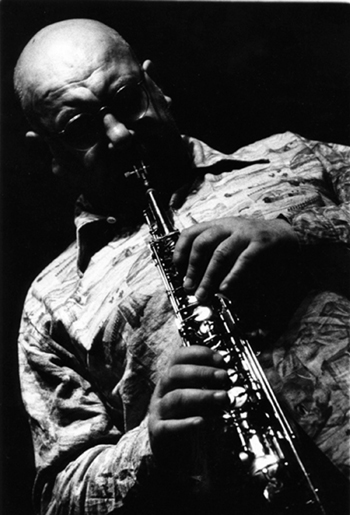
Lol Coxhill, London,
1983
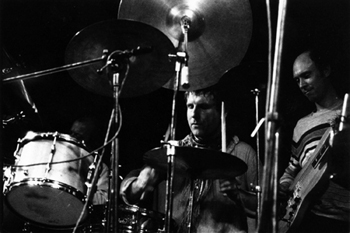
Pip Pyle (drums) with Richard Sinclair (bass) London, 1983
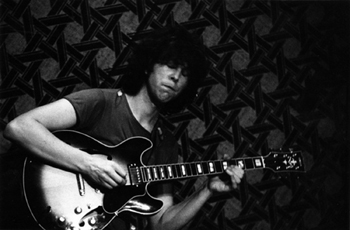
Phil Miller (guitarist) London, 1983
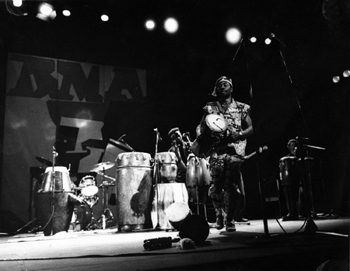
Gaspar Lawal and his Oro Band, London, 1985
_Burning_Bush_London_1980.jpg)
My friend Byron Lye-Fook (father of Omar Lye-Fook) on stage with his band
Burning Bush, live at Meanwhile Gardens, London, W9. 1980.
(more archive photographs coming here soon)
PAINTINGS
The 'Art Attacks Apartheid' Exhibition 1979 to 1982*
Martin Lovis created the Art Attacks Apartheid exhibition in 1978 as an independent, humanitarian, non-exploitative artworks campaign directed against the South African apartheid regime and to raise public awareness of the apartheid reality.
He independently exhibited these works from 1979 to 1982.
The pictures and captions of the exhibition were not offered for sale.
This web page content was first published online in 2017 to provide historical context to present day South Africa.
"Never,
never and never again shall it be that this beautiful land will again experience
the oppression of one by another".
(President Nelson Mandela at his 1994 presidential
inauguration)
----------------------------------
Pictures and Captions by Martin Lovis.
Note - All images contain indelible and almost invisible watermarks

The
Nationalist Total Strategy for South Africa
From
left to right:
Chief of the South
African Defence Force.
Prime Minister and Minister of Defence.
Minister of Co-operation and Development (Bantu Affairs).
Administrator of South West Africa (Namibia) and previous Chairman of the
Afrikaner Broederbond.
Picture Size: 59cm x 50cm. Mixed media, collage, watercolour on board. 1980.
---------------------------------------
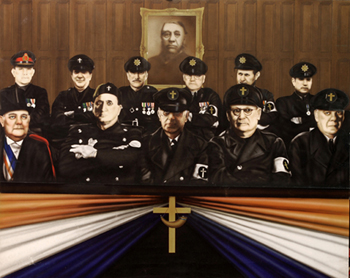
The
Directors of the Christian National Calvinistic Afrikaner Republic of South
Africa
Fascism is a nationalist, anti-communist, authoritarian, extreme right-wing political creed. Contrary opinions are not allowed. Justice is in the service of the State. War is desirable to secure the power of the State. Racial inequality is a dogma. Those who belong to the wrong religion, political party or race are outside of the law.
Mr B. J. Vorster, when he was Prime Minister of South Africa, said, “In Germany it was called National Socialism. In Italy, Fascism but we in South Africa call it Christian Nationalism.”
Back row from
Left to Right:
Chief of the South African Defence Force
Leader of the National Party in the Transvaal
Minister of Police and Prisons
Minister of Justice
Commissioner of Police
Chief of the Security Police
Front row from
Left to Right:
ex Prime Minister and ex State President of South Africa (1966 –1978)
ex Prime Minister of South Africa (1954 – 1958)
Prime Minister of South Africa and Minister of Defence (1978 -?)
ex Prime Minister of South Africa (1948 – 1954)
ex Prime Minister of South Africa (1958 – 1966)
Wall Portrait:
Paul (“without God I attempt nothing”) Kruger:
Father of Afrikaner (Boer) Nationalism
Picture Size: 60cm x 48cm. Mixed media, collage, watercolour on board, 1980.
----------------------------------
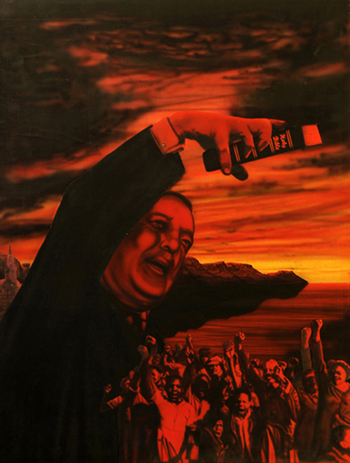
Cape
Moderator of The Nederduitse Gereformeerde Kerk (N.G.K.)
(a.k.a. The Dutch Reformed Church)
The N.G.K. minister is the shepherd of the flock. He is the interpreter of God. Members of the Government regularly consult N.G.K. ministers on matters of State.
All National Party leaders are staunch Calvinists. Most N.G.K. ministers are members of the National Party. Over 70% are members of the Afrikaner Broederbond. The N.G.K. invests heavily in National Defence Bonds (Bonus Bonds). The N.G.K. is split into four racially segregated churches, one for each racial group (White, Black, Coloured and Asian).
The constitution of
South Africa is based on N.G.K. dogma. It believes that: - The State of
South Africa is divinely ordained and created by God, and is the manifestation
of the will of God. The separation and distinction of different racial groups
was ordained by God and God has overriding sovereignty is all political
matters and political rulers are responsible to God alone, being his earthy
agents acting in his name. Laws are God given. If a South African government
does not act in accordance with God’s will, it will lose the mandate
of heaven and can be legitimately replaced.
The doctrine of the N.G.K. rejects the equality of all peoples and the origin
of sovereignty in the mass of the people. It is guided by and justifies
apartheid policy from passages in the bible, e.g.:-
Psalm 105 v43: And he brought forth his people with joy and his chosen with gladness.
Psalm 105 v44: And he gave them the lands of the heathen and they inherited the labour of the people.
Joshua 9 v21: And the princes said unto them let them live but let them be hewers of wood and drawers of water unto all the population.
Joshua 9 v23: Now therefore you are cursed and there shall be none of you freed from being bondmen and hewers of wood and drawers of water for the house of my God.
Deuteronomy 32 v8: When the most High divided to the nations their inheritance, when he separated the sons of Adam, he set the bounds of the people according to the number of the children of Israel.
Picture size: 72cm x 55cm – Mixed media, collage, watercolour on board. 1980.
--------------------------------------------------
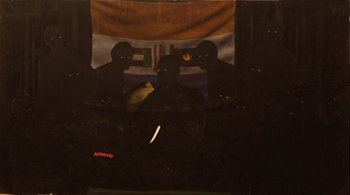
Initiation
To A Secret Cultural Organization
The Afrikaner Broederbond (1974)
The Afrikaner Broederbond (AB) was founded in 1918 with the broad aim of bringing about South Africa’s God given destiny: A Christian National Calvinistic Republic.
Members of the Afrikaner Broederbond must be Afrikaners and members of the National Party (NP).
The Prime Minister and all Cabinet Ministers belong to the AB as well as Dutch Reformed Church ministers, teachers and school officials, university rectors, lawyers, farmers, broadcasting officials, etc. In fact, the tentacles of the AB reach into every corner of South African society and effectively controls the country.
No Prime Minister can run the country without the support of the Afrikaner Broederbond
The set-up of the Afrikaner Broederbond consists of: The Trinity - the innermost nucleus of the Afrikaner Broederbond and consists of a supreme secret chief supported by two assessors who are members of the Executive Council. The Executive Council - consists of 12 members known as “The Twelve Apostles”.
Initiation into the Afrikaner Broederbond. The Afrikaner Broederbond is ostentatiously religious. There is much psalm singing and bible kissing throughout the ceremony. In complete darkness, a corpse-like effigy lies on a bier wrapped in a black sheet on which is embroidered the Afrikaans word VERRARD, which means TREASON. The initiate solemnly swears an oath of allegiance and secrecy to the Afrikaner Broederbond A dagger is trust into the effigy by each member present while the chaplain intones: - “He who betrays the bond will be destroyed by the bond. The bond never forgives and never forgets. Its vengeance is swift and sure. Never yet has a traitor escaped his punishment.”
Up until 1974, the initiation
ceremony of the Afrikaner Broederbond was as described above. However, since
then, only the stabbing of the effigy has been omitted from the ceremony.
It would seem by the stabbing of Dr Robert Smit in 1977 that the oath of
allegiance to the Afrikaner Broederbond remains in place - see the Apartheid
Government Corruption picture (below) featuring Dr. Eschel Rhoodie.
Picture Size: 67cm x 37cm. Mixed media, collage, watercolour on board. 1980.
------------------------------------------------------
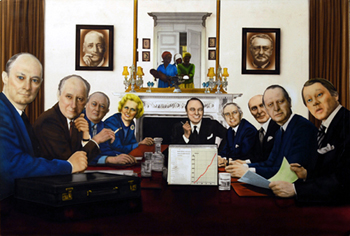
British
Companies Capitalizing on Apartheid
Barclays is banking
on Apartheid
As other multi-nationals take advantage
Of South Africa's cheap labour vantage
Leyland sells its controlling share
But still takes profit from investments there
Rio Tinto steals uranium from Namibia
To fuel the U.K.’s Nu-killer device
Racal/I.C.L sells electronic technology
To computerize government ideology
Thatcher’s government sells North Sea oil
To fuel South Africa’s war on Angolan soil
Anglo American mines resources rife
With little regard for workers life
Consolidated Gold mines the yellow wealth
With no regard for workers health.
(by Martin Lovis)
From Left to
Right:
Chairman of Barclay’s Bank International.
Chairman of Barclay’s Merchant Bank.
Chairman of Barclays Bank Group.
British Prime Minister and Leader of the British Conservative Party.
Chairman Anglo American Corporation of South Africa
Chairman of Racal.
Chairman of Rio Tinto Zinc.
Chairman of Consolidated Gold.
Chairman of British Leyland.
Wall Portraits:
Left: Founder of: Anglo American Corporation of South Africa
Right: Founder of: De Beers (Diamond Mining) and Rhodesia
Centre Mirror:
Put yourself in their position. What would you do?
At the meeting, the
Chairman of the Board accepts apologies for the absence at the meeting of
the Chairmen of the 600+ other British Companies capitalizing on South Africa.
There are hundreds of other foreign (not British) companies investing in
apartheid South Africa.
Picture size: 79cm x 54cm. Mixed media, collage, watercolour on board. 1980.
--------------------------------------------
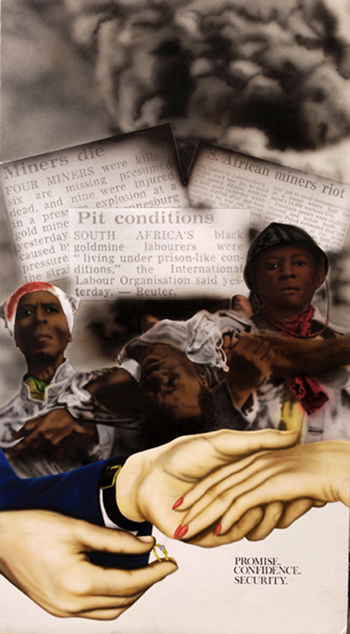
Diamond
(Star of Africa)
Diamond, Star of Africa
I’m looking through you
The view is just the same
She said without one
She couldn't’t take his name
This token of love
Symbolizes a broken heart
Precious to you
Pressure to them
A promise to wed
A promise to dread
It cost you a lot
It cost him his life
And its mine all mine
Death down the mines
Diamond, Star of Africa
Your light is hidden now
Covered by the clenched white fist
Wrapped around a broken wrist
Anglo American Corporation
Scouring the land – mutilation
Taking without right – humiliation
Indigenous population – degradation
The weight and the cut
To have and have not
The reason now is crystal clear
They’re only here for De Beers.
(Martin Lovis)
Picture Size: 71cm x 39cm. Mixed media, collage, watercolour on board. 1980.
--------------------------------------------
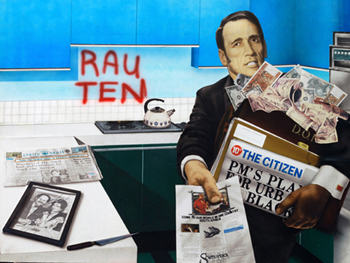
Apartheid
Government Corruption
featuring South Africa's Department of Information Chief:
Dr Eschel Roodie.
Dr Robert Smit, a former director of the International Monetary Fund, prominent economist, National Party (NP) candidate and tipped to be the next Minister of Finance, somehow uncovered details of Government corruption (Muldergate) before the story broke in the South African press.
Speaking at the Rand Afrikaans University (RAU) on 10 September 1977, Dr Smit said (as featured on the front page of the Rand Daily Mail newspaper shown in the picture above), he had “information that would rock the nation”. He spoke to friends about corruption that went “right to the top” and that he was going to inform a senior Cabinet minister. Some weeks later, on November 22nd, he and his wife (shown in the broken picture frame) were brutally murdered in their home, both being stabbed several times ("he who betrays the Bond, will be destroyed by the Bond").
There was much media speculation about what could be the meaning of ‘RAU TEN’ sprayed on the walls of the Dr Smit home? Could it refer to his speech at the Rand Afrikaans University of 10 September 1977? The South African apartheid police thought it represented the Revolutionary Azanian Union (RAU) (no such organization has ever existed) and that Dr Smit was the first of ten to be assassinated by the RAU.
Within the next few weeks, amid South African press speculation, the Department of Information (D.O.I.) scandal broke when South Africa’s Department Of Information (propaganda) Chief, Dr Eschel Rhoodie, (pictured holding the briefcase) was conveniently out of the country.
‘Muldergate’ was about Government Information Minister Connie Mulder using government money to secretly fund the establishment of The Citizen, a new English language newspaper aimed at black Africans, to sway its readers into supporting National Party (NP) apartheid policy with false information articles and stories.
Picture Size: 58cm x 45cm. Mixed media, collage, watercolour on board. 1980.
------------------------------------------------
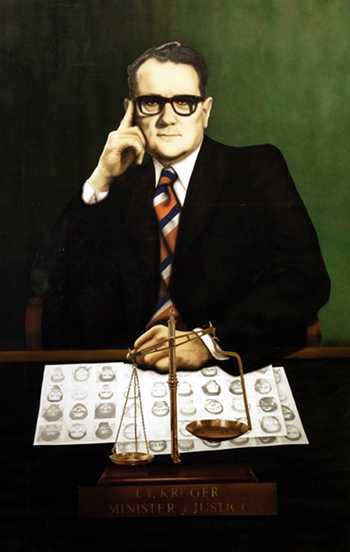
Portrait
of "Mr" Jimmy Kruger – Minister of “Justice”
Jimmy Kruger was the Minister of Justice at the time of Steve Biko’s death.
He announced to a laughing National Party Congress in Pretoria. “I am not glad and not sorry about Mr Biko’s death – he leaves me cold”.
Many others who died in detention also “left him cold” during his term in office.
Picture Size: 80cm x 54cm. Mixed media, collage, watercolour on board. 1980.
-------------------------------------
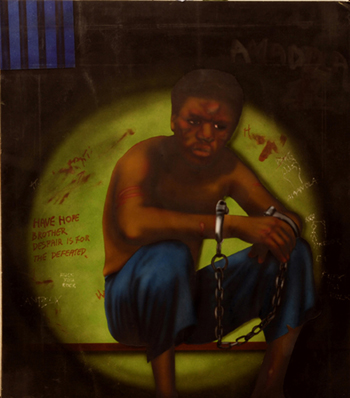
Detained
Indefinitely
Under Section 6 of the Terrorism Act, a person may be detained indefinitely in South Africa without access to a lawyer or their family.
Many such detainees die alone of injuries sustained in a “scuffle” in a police cell or by other “accidents” recorded on police files as, for example, “fatal head injury was caused by slipping on a bar of soap while taking a shower”.
The Police Amendment Act 1979 and the Prison Act prevent the press from publishing information about prisons and political detainees that has not been authorized by the Police.
Handcuffs (and leg irons) are always put on tight.
Picture size: 48cm x 42cm. Mixed media, collage, watercolour on board. 1980.
-----------------------------------------

Department
of Community Development
Squatter camps are created by the homeless people of official Townships as well as the migrant contract labourers from the Bantustan's illegally living together with their families.
The Department of Community Development often “develops” the squatter camps into vacant bulldozed land.
Heavily armed police always stand by in full riot gear in case the community protests.
Picture size: 77cm x 54cm. Mixed media, collage, watercolour on board. 1980.
----------------------------------------------------
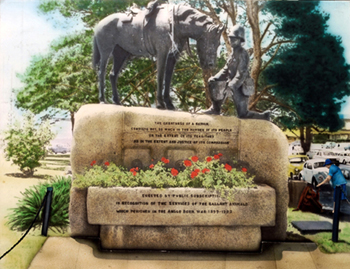
The
Horse Memorial at Port Elizabeth
White South Africa is great in its love of animals, but small in compassion for all of its people.
The memorial inscription
says:
The greatness of a nation consists not so much in the number of
its people or the extent of its territory as in the extent and justice of
its compassion.
Erected by public subscription in recognition of the services of the gallant animals which perished in the Anglo Boer War 1899 - 1902
Picture size: 58cm x 45cm. Mixed media, collage, watercolour on board. 1980.
----------------------------------------

Illegal
Family – African Home Life
This African home, like most others, does not have running water or electricity. Newspapers and magazines serve for wallpaper. The warm, comfortable, secure surroundings depicted in the newspaper and magazine ads are no more than wallpaper anyway, as very few non-whites notice the benefits of living in one of the richest countries in the world.
In South Africa it is illegal for whites to marry or have sexual relations with non-whites.
It is legal for non-whites to marry other non-whites, but it is illegal for them to live together as, under the Group Areas Act, Africans are not allowed to live in a “Coloured” area, or vice versa.
This man is classed as “Coloured” under apartheid rule and his wife classed as “African”. They are living together secretly. If caught, the break-up of the family is guaranteed.
The law affecting non-whites
in South Africa is always ruthlessly enforced.
Picture size: 64cm x 50cm. Mixed media, collage, watercolour
on board, Martin Lovis, 1980.
-------------------------------------

The
Group Areas Act - District Six- Cape Town
The Department of Community Development is also responsible for enforcing the Group Areas Act, and stipulates which area each racial group is allowed to reside in.
Any of these areas may be re-classified if the Authorities so decide.
The population is then forcibly evicted and sent to another area where there may or may not be houses.
This was District Six, a so-called “Coloured” area – re-classified as “White” and bulldozed for redevelopment into an exclusively “Whites Only” residential estate.
Those who don’t
“qualify” for re-housing are left to fend for themselves.
Picture size: 40cm x 30cm. Mixed media, collage, watercolour
on board, Martin Lovis, 1980.
----------------------------------------
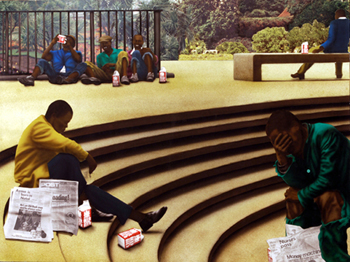
Bantu
Beer
In 1938, South Africa’s white-run municipal governments plunged into the beer business. City-run breweries began producing vast quantities of so-called Bantu Beer. It is thick, sour, varies in colour, and contains roughly 2% alcohol.
The municipal city governments sell the beer at city-run beer parlours and African township beer halls. Returns from sales of over one million gallons of Bantu Beer a year are handsome.
The cities and township councils use their Bantu Beer profits to pay for the limited welfare program for black people, thus sparing the white taxpayer the burden of providing for the poor and needy of the community.
For some Africans, drinking
is no more than a social catalyst and pleasant stimulant. For many others,
the oppressed and rootless that trudge the cities from day to day without
hope, drinking is the fast escape. It is the only way for a man to un-shoulder
the burden of his troubles for a few hours - to drown them if he can.
Picture Size: 50cm x 38cm. Mixed media, collage, watercolour
on board, Martin Lovis, 1980.
---------------------------------------
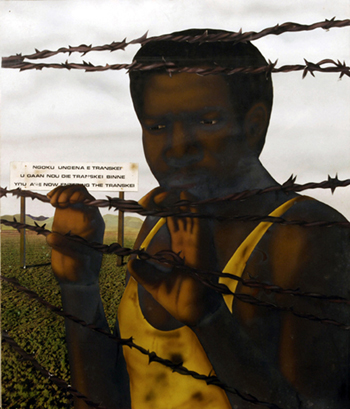
Welcome
To The Transkei Bantustan
Bantustan's are the cornerstone of “Separate Development” (Apartheid) in South Africa. The Transkei Bantustan is one of the 10 Bantustan's in South Africa that are controlled by African Chiefs appointed and paid by the South African Government. Bantustan's are, according to the South African Government, the legal dwelling place for an African tribal group.
It is illegal for an African to dwell anywhere else outside of their designated Bantustan unless a special permit (Pass Law) is given inside the Passbook, which all black Africans must carry.
Bantustan's are not independent states as they are tied politically and economically to the South African Government. The South African Government call them “satellite” states. Bantustan's consists largely of barren land and have few, or no, natural resources. Bantustan's have large areas of soil erosion where it is difficult to cultivate food or raise stock and have widespread malnutrition and starvation. It is a fact that half the babies born in Bantustan's die before the age of five years.
Gambling, sex shows, etc are not allowed in white South Africa but white controlled business capital is rapidly developing these “attractions” inside Bantustan's for whites that frequently make weekend trips to the new “entertainment” clubs and casinos.
Bantustan's are in fact the “native reserves” of labour for South African industry and also the dumping ground for those not needed by the white economy – widows, old people, children, the unemployed and the sick.
Bantustan's are the home of those forcibly removed from South African urban areas under the Pass Laws. The most committed “crime” of black Africans in South Africa is to be without a Pass Book permit and this effectively makes them illegal immigrants inside their own country. Those so caught are “endorsed out” of South Africa and forcibly sent back to their Bantustan.
Bantustan's are imprisoned
societies.
Picture size: 44cm x 38cm. Mixed media, collage, watercolour
on board, Martin Lovis, 1980.
------------------------------------------------
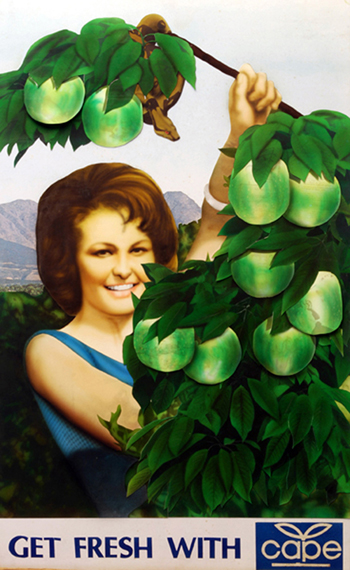
Apartheid
Fruit is Rotten Fruit
Look more closely before
you buy the fruits or wines from South Africa’s Garden of Eden.
Picture size: 63cm x 39cm Mixed media, collage, watercolour
on board, Martin Lovis, 1980.
----------------------------------------
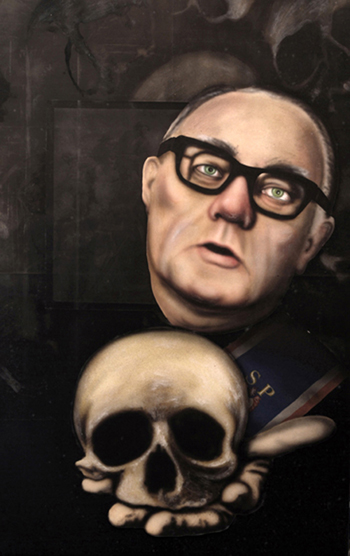
Portrait
of Balthazar John Vorster
ex Minister
of South African Police and Prisons
ex South African Minister of Justice
ex Prime Minister of South Africa
ex State President of South Africa
ex member of the human race.
Picture size: 78cm x 49cm. Mixed media, collage, luminous
paint gel and watercolour on board, Martin Lovis, 1980.
----------------------------------------------
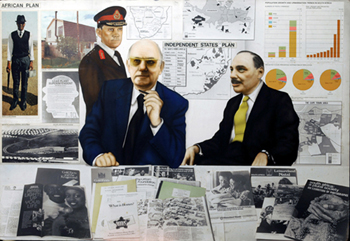
The
Grand Design: Reforming Apartheid
Apartheid (pronounced Apart-Hate) is an Afrikaans word meaning “separate development”. The “Grand Design” is a carefully concocted plan to “develop” a middle class elite of Africans living in white South Africa. Under the plan, the majority of the African population (those not required by white business) will be confined to the Bantustan's (labour reserves).
As there is no real Government Social Welfare system for non-whites in South Africa, the Urban Foundation was created by Sir Harry Oppenheimer (Chairman of the Anglo American Corporation) to provide limited funds to brighten up African township homes and the shantytowns. The Grand Design is a plan to project to the world a more acceptable face of Apartheid. The success of the plan depends on a continued increase in overseas investment in South Africa, the immigration of thousands of white skilled workers, and the continued oppression of all those opposed to the plan. Limited changes will have to be made. Real change is not part of the plan.
The architects of the
Grand Design are:
From Left to Right:
Chief of the South African Defence Force.
Prime Minister of South Africa and Minister of Defence.
Chairman Anglo American Corporation.
The information and
images depicted in the picture are original copies of South African Government
produced documents and statistics taken from South African magazines, tourist
guides and the Optima business publications published by the Anglo American
Corporation.
On the background wall, the township house shown is unusual but the one
just visible next door with the corrugated roof is much more typical.
The Independent States Plan (Bantustans) are not independent.
The Urban areas shown on the display are all segregated according to race.
The Lead Plant
Supervisor job ad appeared in an October edition of the British
Guardian Newspaper and shows the profile of a European.
On the table is a selection of magazines aimed at middle class africans,
apartheid government publications and Optima business magazines. South Africa
- A Plural Society was produced by the Apartheid Department of Information
and is deliberately designed to closely resemble the boxed photographic
exhibition produced by the International Defence and Aid Fund
for Southern Africa (IDAF) which more accurately
shows the reality of living in South Africa's "plural society"
especially if you are not white.
Picture size: 79cm x 55cm. Mixed media, collage, watercolour
on board, Martin Lovis, 1980.
---------------------------------------------

Apartheid
Control
South African Prime Minister Mr. P. W. Botha controls friends, neighbours and opportunists.
Neighbours and Opportunists
on stage
from Right to Left:
Head of UNITA
ex Prime Minister Zimbabwe/Rhodesia
Prime Minister of South Africa
ex Prime Minister of Rhodesia
Prime Minister & Leader of the Democratic Turnhalle Alliance of South
West Africa
President and Chief of Transkei Bantustan
Chief of KwaZulu Bantustan.
Friends in the audience
from Right to Left:
President of France
President of the United States of America
Chancellor of West Germany
Prime Minister of the United Kingdom
Prime Minister of Israel.
Picture size: 68cm x 55cm. Mixed media, collage, watercolour
on board, Martin Lovis, 1980.
----------------------------------------
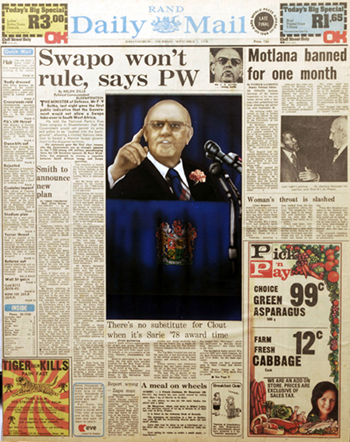
White
People Take Comfort in False Prophets
Headline statement made on 7 September 1978 by South African Prime Minister P.W. Botha.
In 1973 the United Nations
General Assembly accepted SWAPO as the authentic representative of the Namibian
people and granted full observer status in 1976. SWAPO is the first people's
popular liberation movement to have achieved this status.
Picture size: 57cm x 44cm. Mixed media, collage, watercolour
on board, Martin Lovis, 1980.
--------------------------------------------
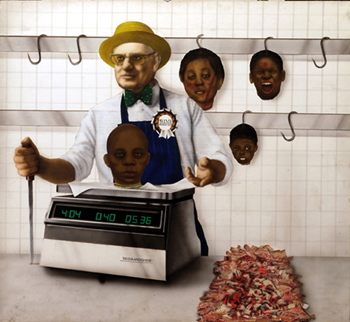
The
apartheid “PRIME” Minister of South Africa
Execution (regvaardigheid, in Afrikaans) is a widely used “remedy” for resistance in South African justice; the scales of which are tipped in the favour of the Baas (Boss).
Prime Minister directed the South African Defence Force raids on the SWAPO refugee camps – Kassinga (pictured above in the pile of "boys meat scraps") in the South African/Angolan war of 1975.
He further ordered Police
and Security Forces to violently attack SOWETO school children participating
in the peaceful schools boycott demonstrations in 1980 and stated to the
nation via the government controlled South African Broadcasting Corporation
(SABC), “They will bear the full brunt of the law”.
Picture size: 60cm x 54cm. Mixed media, collage, watercolour
on board, Martin Lovis, 1980.
----------------------------------------
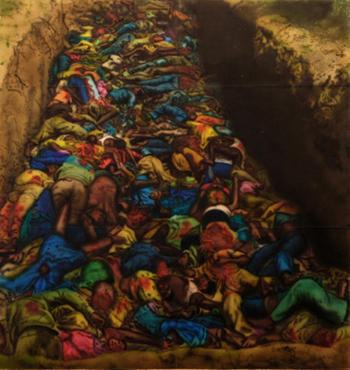
Operation
Moscow (Search and Destruction of Communists)
The Raid on Kassinga, Angola*
On 4 May 1978, the South African armed forces penetrated 180 miles inside Angolan territory to carry out an attack code named “Operation Moscow”.
According to official South African military sources Operation Moscow was a success resulting in the total destruction of a major guerrilla camp. It was in fact a South West African Peoples Organization (SWAPO) refugee and military camp.
The raid resulted in the death of 300 children, 294 Women and 165 Men. 63 people are still missing and a further 137 people are held by the South Africa Defence Force at a concentration camp near a place called Hardap Dam in South West Africa (Namibia) which South Africa controls under U.N. mandate.
Operation Moscow was only one attack. The South African Defence Force carry out almost daily attack raids into Angola from South West Africa, which amounts to a state of undeclared war against the Angolan people.
*Note - This picture
is not a collage. It is an enlarged black and white photograph of one of
the mass graves at Kassinga that I hand tinted with colour.
Picture size: 53cm x 49cm. Colour tinted monochrome photograph
(photographer unknown) on board, Martin Lovis, 1980.
----------------------------------------
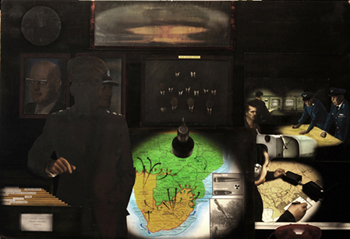
The
Department of Military Intelligence (D.M.I.)
Chief of Staff of the Department of Military Intelligence is a shadowy figure and consequently almost no photographs of him exist in public circulation.
As South Africa moves closer towards a war economy, the process of militarism can be seen in the promotion of the Department of Military Intelligence (D.M.I.) over the National Intelligence Service (N.I.S.).
This process can also be seen in the promotion of the State Security Council from an advisory role (under previous Prime Minister Vorster) to its now central position of “Conducting the National Strategy”.
Sophisticated electronic technology including computers, surveillance, weapon systems and communications equipment – is now a vital part of the security forces operations.
Opposition to the South African Nationalist Government is not confined to the Republic. Measures taken against this opposition are not confined to the Republic either. South Africa’s forces raid neighbouring states on an almost daily basis, the targets of which are not necessarily military.
Thanks to the assistance of the American Central Intelligence Agency (C.I.A.), the British Cementation Company, the Canadian Space Research Corporation, the First Pennsylvanian Bank, and others, the South African military recently obtained an advanced artillery system. The 155mm artillery gun depicted is apparently capable of delivering a low yield nuclear warhead and is ideal for such a device as the neutron bomb – an enhanced radiation weapon that can, within a certain radius, destroy all life but leave property undamaged. It was originally designed as a device to knock out tanks. United States President Jimmy Carter’s sham investigation into the mystery surrounding the apparent test explosion of a nuclear device above the sea around South Africa in September 1979, “concluded” that no traces of a nuclear explosion could be found in the atmosphere. A Neutron explosion would explain the absence of nuclear debris.
Note: The photographs of the 155mm artillery weapon (shown in the spotlight) were taken by members of the Committee Of South African War Resisters (COSAWR) and smuggled out of the country and copies of them passed to me for inclusion in this picture.
Picture size: 80cm x 54cm. Mixed media, collage, watercolour on board, Martin Lovis, 1980.
------------------------------------------
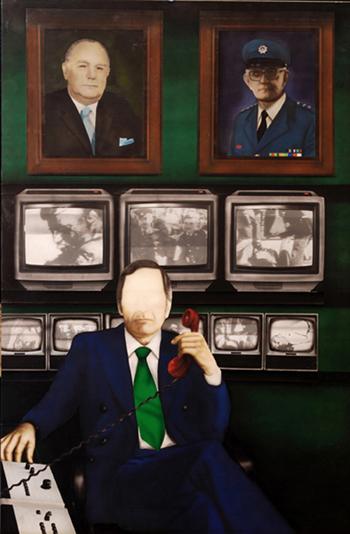
The
Boss of B.O.S.S.
No photographs exist in the public domain of the chief of the South African National Intelligence Service (N.I.S.) formerly The Department of National Security (D.O.N.S.) formerly The Bureau Of State Security (B.O.S.S.).
Established in May 1969, B.O.S.S was created by Prime Minister B. J. Vorster (pictured top left) and Chief of Security Police, General Van den Burgh (pictured top right) who was the first Head of B.O.S.S.
The South African Intelligence Service has a vast network of agents and informers operating inside and outside South Africa. Secrecy shrouds its operators and operations. Its official function is to “overtly and covertly gather and evaluate all matters affecting the security of the State”. The South African Government believes that Liberal and Christian (including churchmen) activities and opposition directed against White Supremacy, Apartheid and National Party rule, are inspired by Communism.
B.O.S.S. is the brains behind the Security Police (S.P.). B.O.S.S. evaluates information and operational plans and directs Security Police operations. B.O.S.S. has no powers to arrest, detain, interrogate, torture, ban or imprison anyone. These functions are reserved for the Security Police and the Courts. The Security Police, apart from carrying out the orders of B.O.S.S., makes its own decisions, recruits agents, detains suspects, and prepares its own evidence to procure banning orders.
Under Prime Minister Balthazar Vorster, military and security police were responsible for “routine monitoring”. Information so gathered was to be passed onto B.O.S.S. for evaluation and then, after the formation of plans, onto the Prime Minister via his personal security advisor, General Van den Burgh.
Under the new security
system of Prime Minister and Minister of Defence Mr P.W. Botha, such information
is to be passed directly to the Department of Military Intelligence
(D.M.I.).
Picture size: 78cm x 53cm. Mixed media, collage, watercolour
on board, Martin Lovis, 1980.
----------------------------------------------
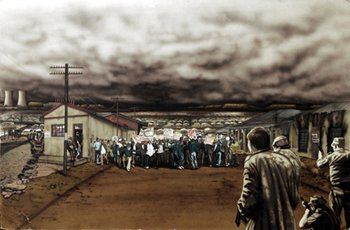
SOWETO
– June 16th 1976*
SOWETO is an acronym for South West Township - a huge African township outside Johannesburg.
Just like another Sharpville massacre, Police opened fire on students bravely demonstrating (peacefully) against the Apartheid government ruling that school lessons taught in English were in future to be taught in Afrikaans, the hated language of the ruling Apartheid government.
As a result of the police violence, over 500 people, mostly students and school children, were killed. Tens of thousands of students' and school children's injuries included, wounding, blindness, loss of limbs and total paralysis as a result of shotgun buckshot.
Police attacks on student demonstrations continued throughout 1976 and spread right across South Africa and right up until the present day (1982).
*The
above picture was featured as an unusual gate fold cover for the book entitled
'Whirlwind before the Storm' published by the International Defence and
Aid Fund for Southern Africa (IDAF) in 1980.
Picture size: 92cm x 61cm. Mixed media collage watercolour
on board, Martin Lovis, 1980.
--------------------------------------------
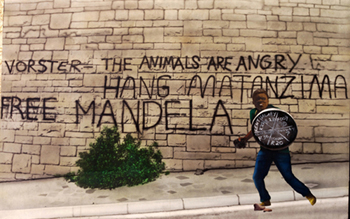
Student
Uprisings Continue to Spread – After SOWETO 1976
The student unrest that began in Soweto on June 16th 1976 continued all over South Africa for the rest of that year and to the present day.
Blacks in South Africa do not have the vote so their feelings about their place in the “Grand Design” have to be made known extra-parliamentary.
Bin lid protest is no shield against police bullets.
South African police riot control can be summed up by the police officer that stated “We’ll start using rubber bullets when they start throwing rubber stones”.
Under South African Law; any person who damages any building (e.g. breaks a window) in the course of a demonstration (illegal in South Africa) calling for the grant of increased rights to all South African people (illegal in South Africa) is guilty of the offence of sabotage unless he proves that his act was not calculated or intended to encourage feelings of hostility between white persons and Africans.
Student protesters did the wall graffiti shown and also the bin lid economic hardship statement shown, which illustrate how the SOWETO student protest, begun as a protest about the Afrikaans language ruling in schools, escalated into a more widespread uprising against apartheid rule.
The writing is on the
wall for the Apartheid Government.
Picture size: 78cm 49cm. Mixed media, collage, watercolour
on board, Martin Lovis, 1980.
-------------------------------------------------
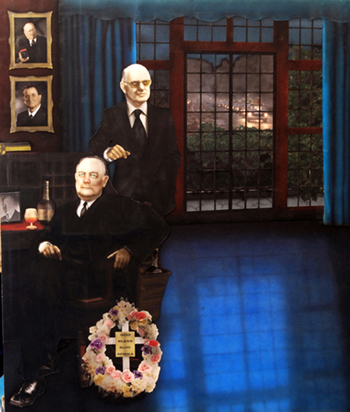
The
Future for Apartheid?
Apartheid was originally a 1948 campaign slogan of the South African National Party (NP) designed to exploit white “sensitivity” to the black African.
The Apartheid concept swept them to political power in the 1948 general elections that they have retained ever since.
Each new Afrikaner Nationalist Prime Minister, of which there have been five, has been more extreme than his predecessor and carried apartheid a step further towards its desired Afrikaner Nationalist Republic of South Africa:
1st Daniel Malan
(pictured top left) 1948 – 1954,
2nd Johannes Strijdom (pictured below top left) 1954 –
1958,
3rd Hendrik Verwoerd (shown in the desk picture frame)
1954 – 1966,
4th B J Vorster (seated) 1966 – 1978,
5th P.W. Botha (standing) incumbent since 1978.
With each apartheid development, black opposition to it has reacted more
strongly, which in turn has motivated the apartheid nationalist extreme
right wing government to strengthen their control and proceed still further
to bring the apartheid policy to its desired “Grand Design”
conclusion but, apartheid will be the South African Nationalist
Government's funeral.
Picture size: 62cm x 52cm. Mixed media, collage, watercolour on board, Martin Lovis, 1980.
-------------------------------------------------------------------------------------------------------------------------------------------------------------------------
*Apartheid was institutionalized in 1948 but was ended in 1994. The process to end Apartheid started in 1990 with the South African Nationalist Government (led by State President F.W. De Klerk) un-banning of the African National Congress (ANC), South African Communist Party (SACP) and the Pan Africanist Congress (PAC). These changes were followed by the release of Nelson Mandela from jail.
Later changes culminated in the first democratic elections held on 27 April 1994.
On 9 May 1994 the newly elected South African parliament elected Nelson Mandela as the first president of a fully democratic Republic of South Africa.
------------------------------------------------
The first Art Attacks Apartheid exhibition was held in 1980 at the University of London Student Union (U.L.U.) building in Malet Street, London.
Between 1980 and 1982, further exhibitions were held at:
Leicester
Polytechnic
Cambridge University (private show)
Quakers Meeting Hall, London
The Africa Centre, London
The Fabian Society, London
Club Voltaire, Frankfurt, West Germany
Camerawork Half Moon Photography Workshop, London
The Africa Centre, London
World Of Music Arts & Dance Festival (WOMAD), Royal
Bath and West Show Ground, Somerset, England
Martin Lovis, media reports, interviews, exhibition brochures, exhibition visitor comments and photographs

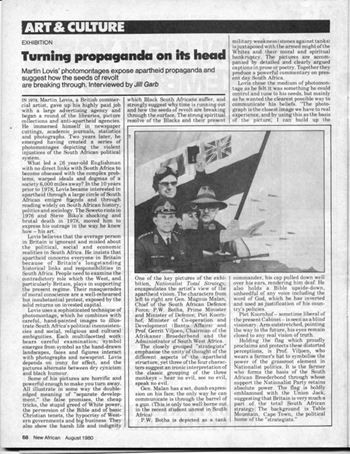
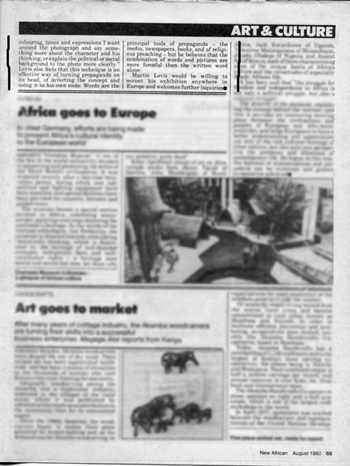
The Turning propaganda on its head, feature
article by Gill Garb, New African magazine
August 1980.
---------------------------------------------
The first exhibition
was followed by a special one day exhibition on Sunday 15th June 1980 at
the
Morning Star - 50th Anniversary - Beat The (Tory) Blues Festival
held at Alexandra Palace, North London.
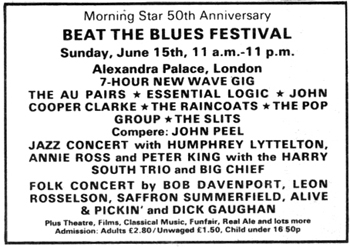
Morning Star Festival advertising (musicians line up) London,
1980.
----------------------------
In November 1980 the exhibition opened at the Africa Centre, King Street, Covent Garden, London.
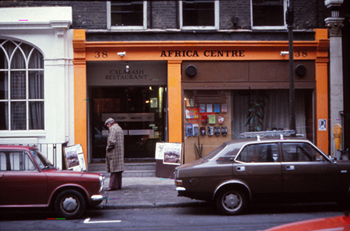
Stopping
the passer-by (quite an achievement in itself) outside the Africa Centre
November 1980.
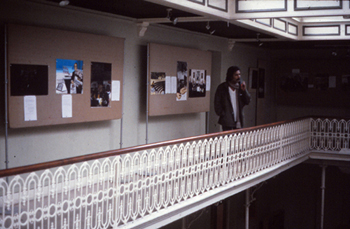
Inside the upstairs
Gallery at the Africa Centre, November 1980.
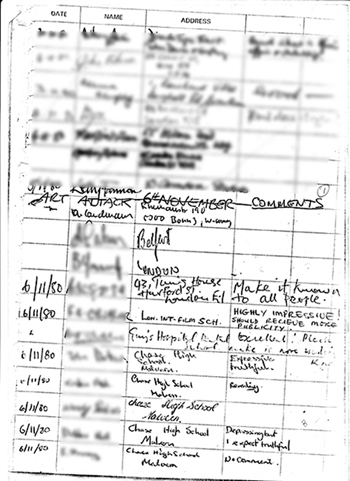
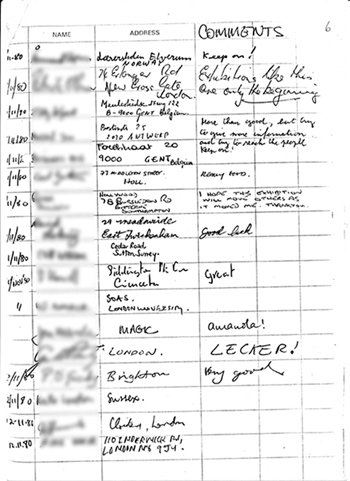
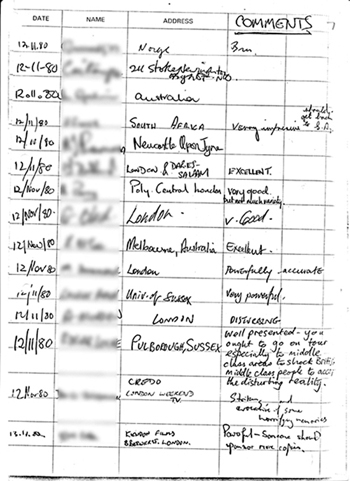
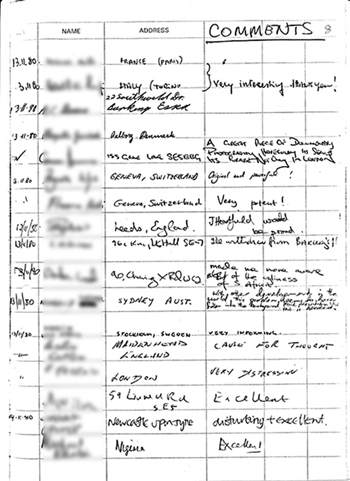
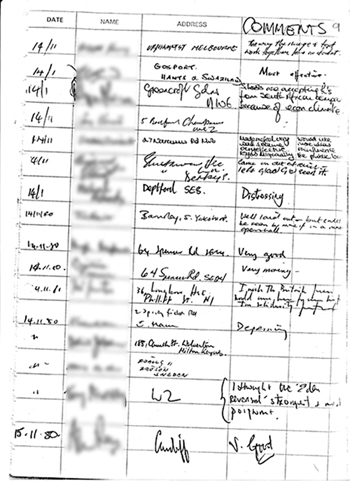
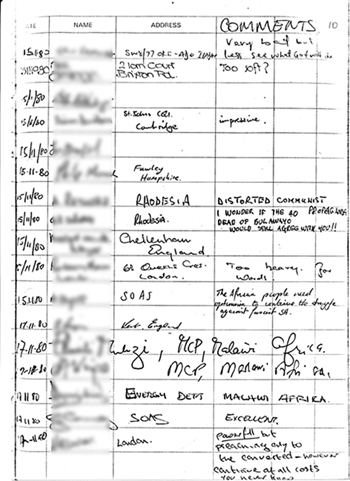
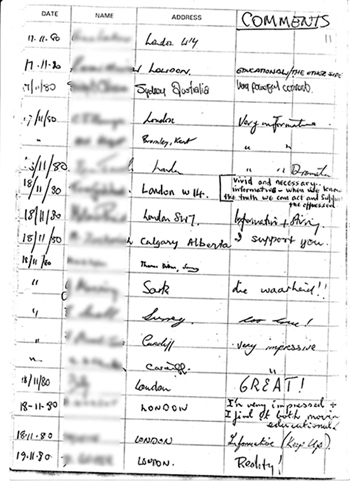
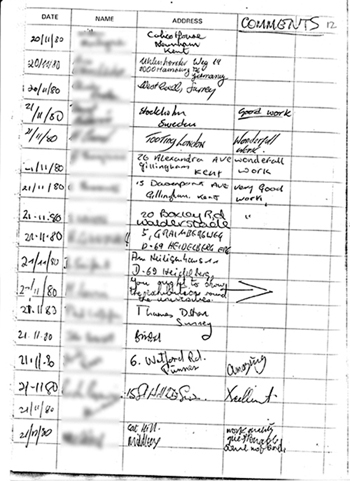
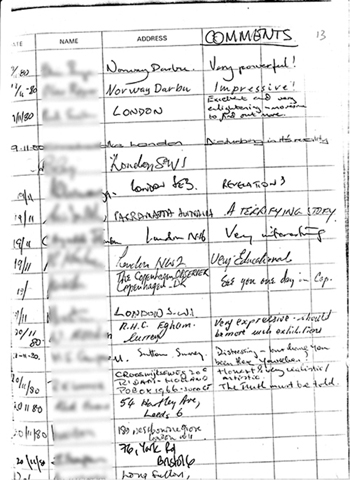
Below: copy
pages from the 1980 Africa Centre Exhibitions Visitors book:
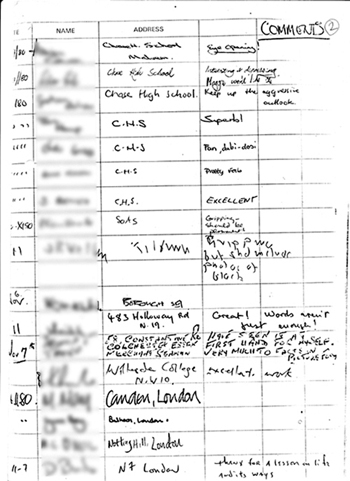
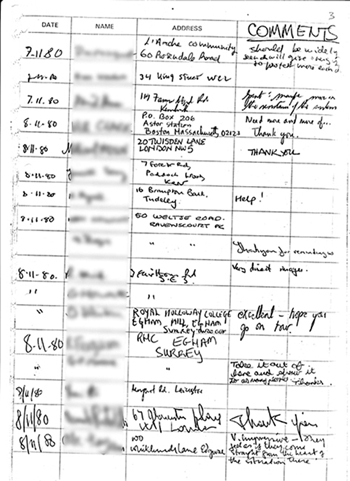
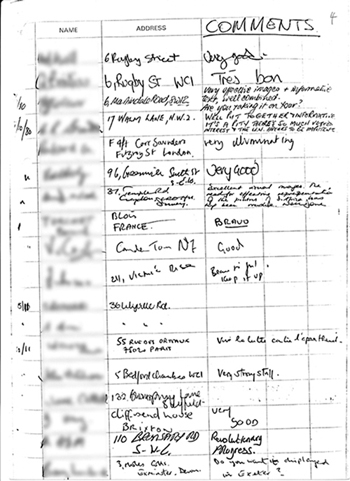
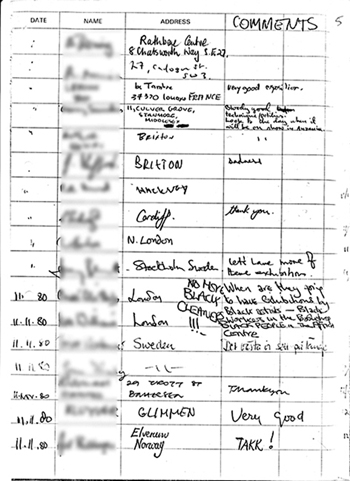
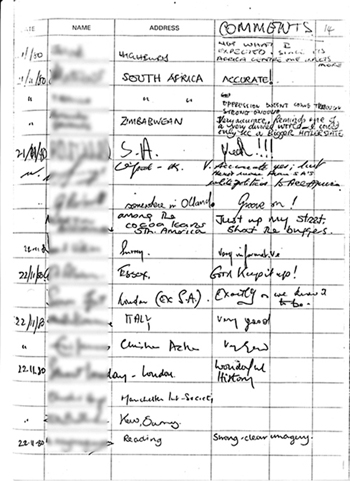
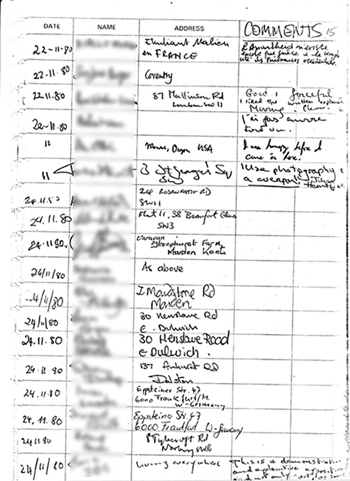
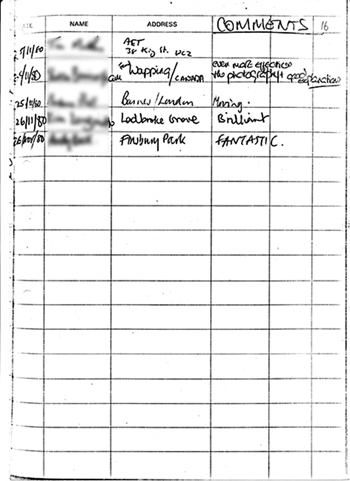
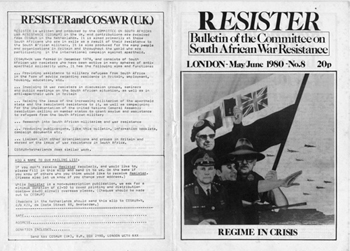
Below: Front cover of the COSAWR May/June 1980 publication RESISTER
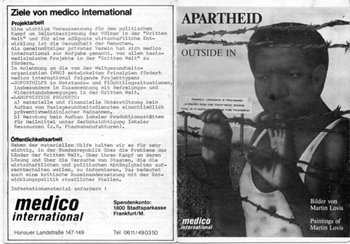
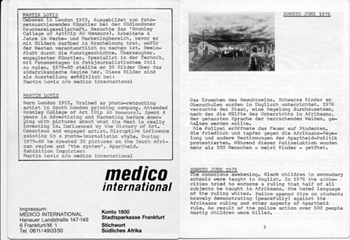
The APARTHEID OUTSIDE IN postcard protest campaign (sample pages) for Medico International
_ml.jpg)
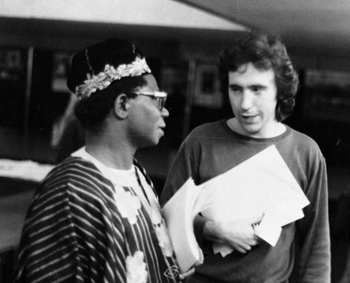
Martin
Lovis in conversation with an exhibition visitor, 1980.
The
Festival of Progressive Poetry Music & Art from Africa
at the Africa Centre London 1981
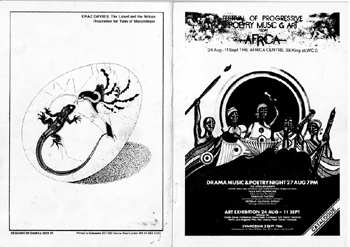
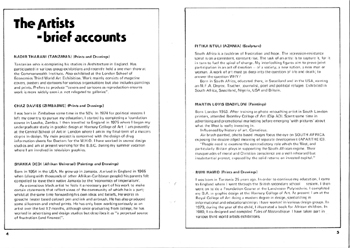
The aims of the Festival were, as stated in the Catalogue:-
"The Festival and Aims to bring together progressive cultural artists from Africa, or working on Africa in Britain, thereby creating a forum for learning and contributing to the development of a genuine popular African culture. To present to the British public some aspects of the largely ignored popular and progressive cultural tradition from and in Africa and thereby publicize the turbulent realities of Africa. Contemporary African art has not yet received the attention that has been increasingly fostered upon historical African art which naturally had past realities as its point of departure. This attention has partly come about as a result of the status of such works as investable objects or, as in the case of mass produced 'airport art', an attempt at an appropriation of mythical Africa. The exhibits on the other hand, attempt to communicate/reflect/criticise the existing realities of Africa including the popular struggles of its peoples by utilising various media including sculpture, cartoon, prints, posters and montages. In the process, some of the works continue the evolution of traditional aesthetic elements".
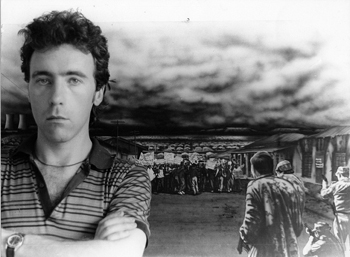
Martin Lovis at the Progressive Arts Festival, Africa Centre,
London, 1981.
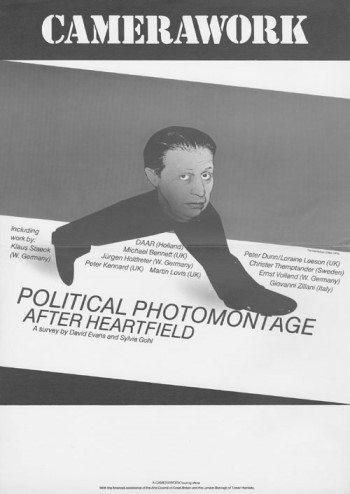
After the Camerawork Half Moon exhibition
The Camerawork
Political Photomontage After Heart field Survey
cover.
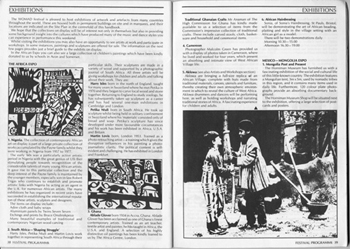
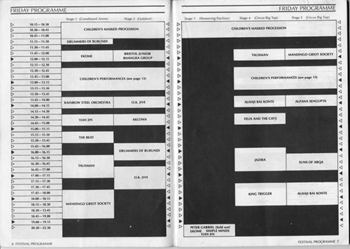
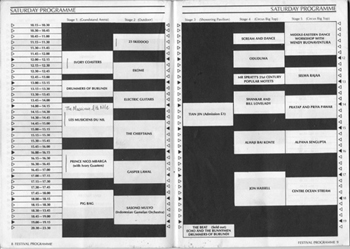
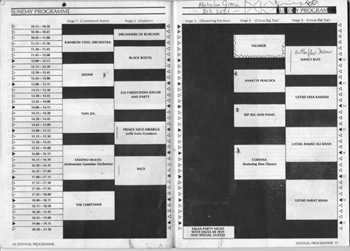
Sample pages from the WOMAD exhibition 1982 catalogue.
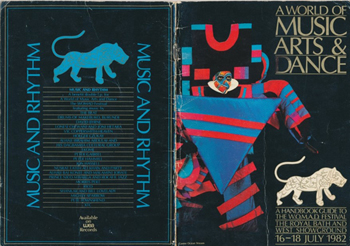
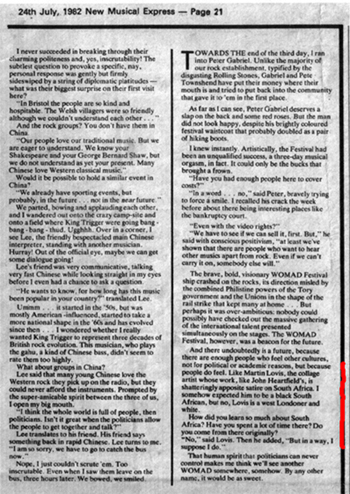
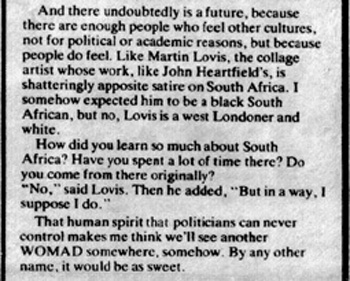
The 24th July
1982 edition of the New Musical Express (NME) by Vivian
Goldman.
Vivian Goldman is an astute journalist, writer and contemporary cultural commentator and she captured, in just so few words, the whole spirit of my artistic purpose.
It was indeed an honour that she gave closing her WOMAD article linking me with the spirit of WOMAD itself.
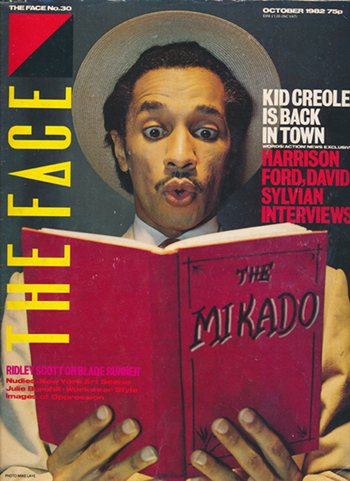
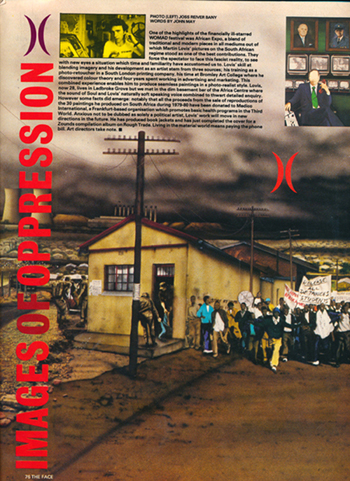

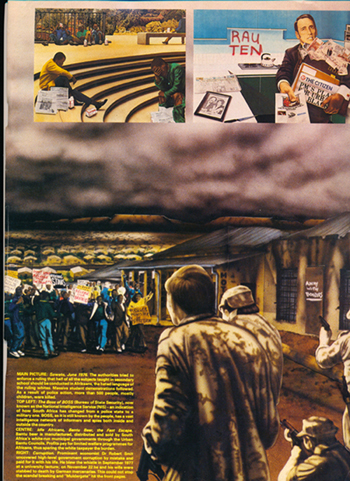
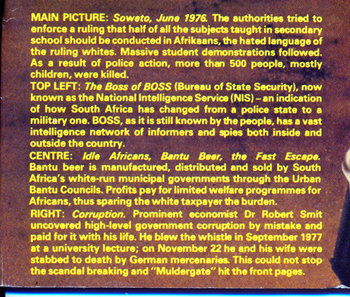
The October
1982 edition of The FACE magazine featured a double page
spread, Images of Oppression, by John May.
The article layout
was designed by art director and typographer Neville Brody
who was at the time just starting, what would become, an illustrious career.
The article
was a stunning example of professional accomplished journalism and targeted
content placement by John May who encouraged the magazine
publisher and editor Nick Logan to recognise the cultural
importance of publishing the article about my work.
At the time, The Face magazine was 'the' cutting edge of
reporting on the progressive music and cultural scene in the U.K. and was
the leading light of news focus for emerging creative talent.
The publishers strictly avoided giving any publicity platform to all political
groups and individuals but after my meeting with Nick Logan,
he was assured of my independent humanitarian position and so the article
was published.
It is almost certain that the positioning of the published article in The Face magazine gave inspiration and encouragement for others to then express their own international humanitarian concerns which, at that time, were stifled by the mainstream media.
What followed the article was Live Aid, the Free Mandela concerts and many other similar expressions by others to raise awareness and propose solutions to end human suffering.
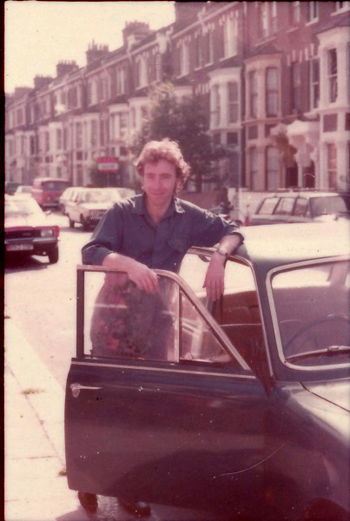
Martin Lovis
outside home, Fermoy Road, London, W9, 1982
ARTWORK ILLUSTRATION COMMISSIONS
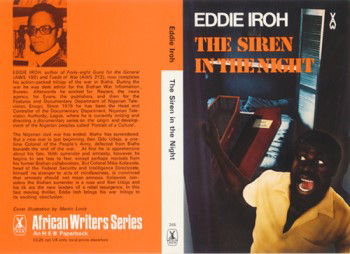
Eddie Iroh, The Siren In The Night, Heinemann African
Writers Series
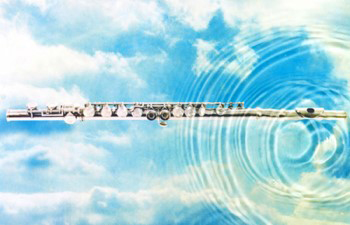
Flute Music Double
L.P, Nachum Heiman, Heiman Music Productions Ltd
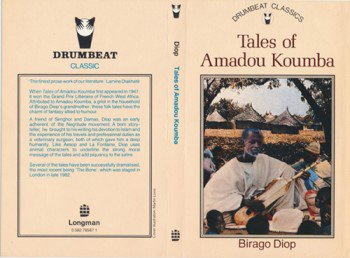
Birago Diop, Tales
of Amadou Koumba, Longman Drumbeat Classics
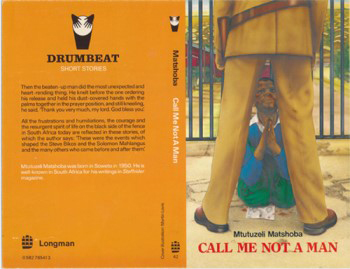
Mtutuzeli Matshoba,
Call Me Not A Man, Longman Drumbeat
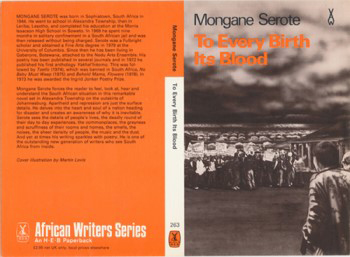
Mongane Serote,
To Every Birth Its Blood, Heinemann African Writers Series
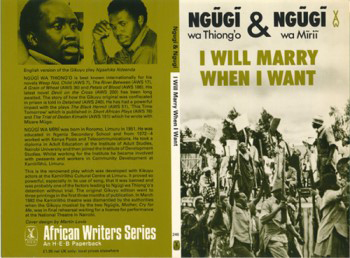
Ngugi wa Thiongo,
Ngugi wa Mirii, I Will Marry When I Want, Heinemann African Writers Series
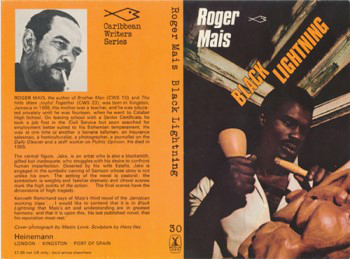
Roger Mais, Black
Lightning, Heinemann Caribbean Writers Series
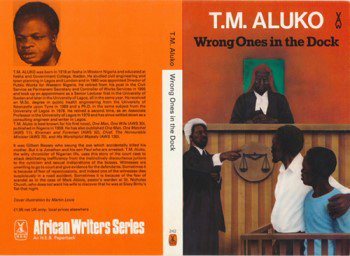
T. M. Aluko, Wrong
Ones in the Dock, Heinemann, African Writers Series
My special thanks to all my artwork commissioning clients.
It was your commissions that kept me going and also feed a very fussy cat.
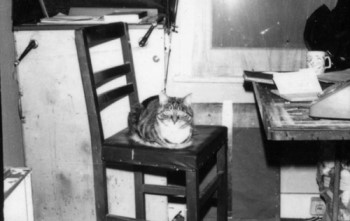
The Cat called Pussy (a.k.a. Crazy Cat) on my studio chair,
London, 1981.
-----------------------------------
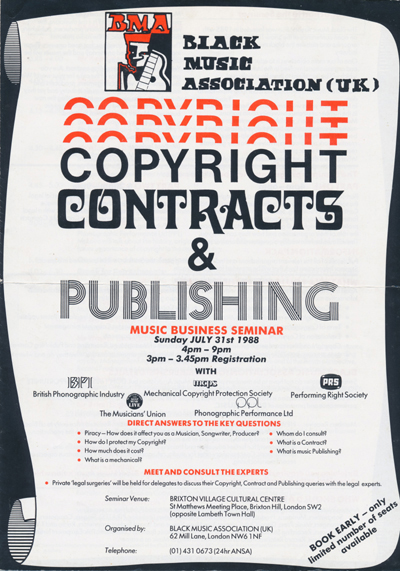
Black Music Association
(BMA) London UK
Copyright, Contracts & Publishing Music Business Seminar July 31st 1988
- Front Cover publicity leaflet
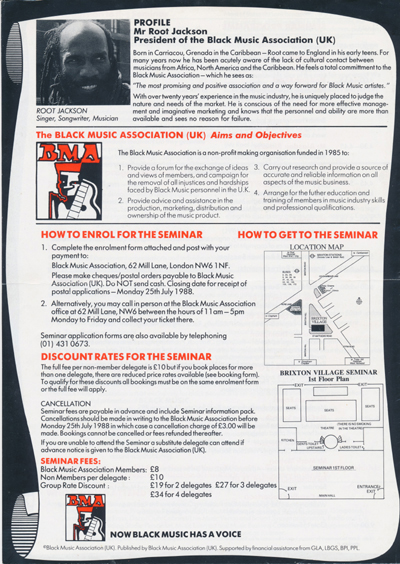
Black Music Association
(BMA) London UK
Copyright, Contracts & Publishing Music Business Seminar July 31st 1988
- page 2 publicity leaflet
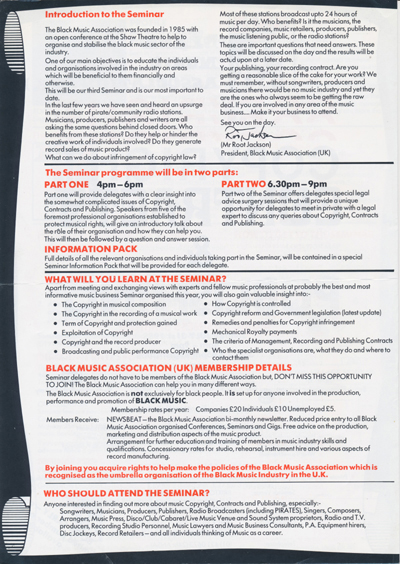
Black Music Association
(BMA) London UK
Copyright, Contracts & Publishing Music Business Seminar July 31st 1988
- Page 3 publicity leaflet
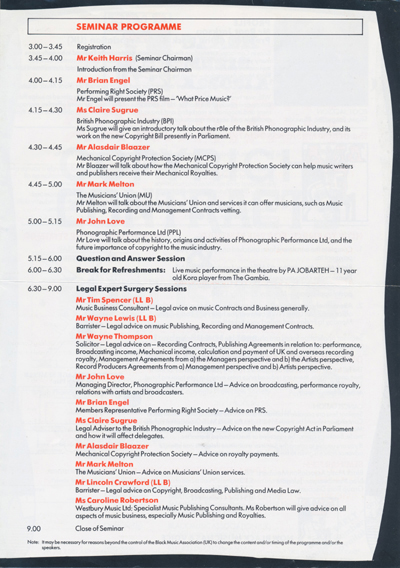
Black Music Association
(BMA) London UK
Copyright, Contracts & Publishing Music Business Seminar July 31st 1988
- page 4 publicity leaflet
The above Promotional
Marketing communications were written and designed by Martin Lovis and produced
with staff
members of the Black Music Association (UK) London in July 1988.
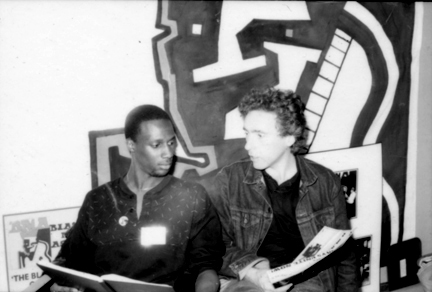
Martin Lovis in discussion with Mr Philip Buchanan, the
Publicity and Membership Officer for the Black Music Association, London,
(1983)
------------------
© Martin Lovis, 2015-2026. All Rights Reserved.